Victor Schrekengost, that is. His work was wide-ranging, and too varied to place him in any single category. He was: artist; sculptor; potter; industrial designer; teacher; and innovator.
He was known to many of his contemporaries’ as the “American DaVinci”.
I admired his work years before I knew his name. The occasion was a trip to the Cleveland Zoo in the mid-1950’s. I went with my family to see the animals. The sculptured Mammoth and Mastodon on the outside walls of the Pachyderm building stayed in my mind longer than anything else I saw that day.
Both sculptures were installed in 1956. I must have seen it only days later. It’s possible Mom planned our trip to the zoo just to see this new wonderous work. It’s the sort of thing she would do. I don’t really know if she planned it or not. I was impressed anyway. It was huge and beautiful. That was enough. It didn’t occur to me to wonder who made it.
Since then, I’ve learned the name of Victor Schreckengost and the many, many, objects of artful imagination he’s produced.
Wikipedia quotes a paragraph from the Vicktor Schreckengost Foundation homepage that’s worth re-quoting.
“Every adult in America has ridden in, ridden on, drunk out of, stored their things in, eaten off of, been costumed in, mowed their lawn with, played on, lit the night with, viewed in a museum, cooled their room with, read about, printed with, sat on, placed a call with, enjoyed in a theater, hid their hooch in, collected, been awarded with, seen at a zoo, put their flowers in, hung on their wall, served punch from, delivered milk in, read something printed on, seen at the World’s Fair, detected enemy combatants with, written about, had an arm or leg replaced with, graduated from, protected by, or seen at the White House something created by Viktor Schreckengost”.
That’s a Mammoth amount of productivity.
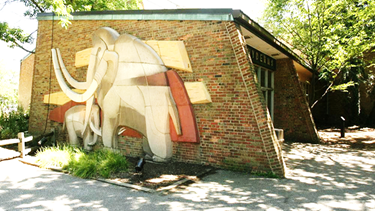
The Mammoth sculpture at the Pachyderm building. (Photo-2008)
For Schreckengost, design was a way of thinking. It was a way of making things that did not allow for distinction between art and craftmanship. I recognize that way of thinking because it is the
same as my own.
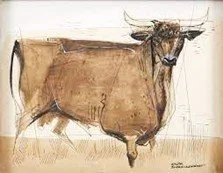
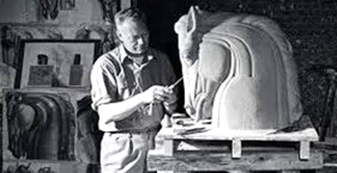

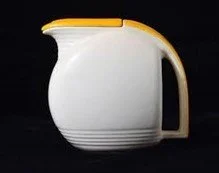
Painting, sculpting, Industrial design, Ceramics – all treated with the same sense of function/design.
The Bauhaus School of Design had a great effect on me; I think it probably had the same effect on Schreckengost. Bauhaus philosophy influenced attitudes about design though most of the twentieth century - and still. I came late to that philosophy, long after the Bauhaus had come and gone. Schreckengost lived through its birth and development. How could it not have influenced him.
Walter Gropius was the man who inspired the Bauhaus viewpoint that distinctions between the fine and applied arts were less important than the design sensibility that united them. The Bauhaus taught the principals of design to artists and craftsmen alike, under one roof. Victor Schreckengost applied those same principals of design to everything he did.
In Victor’s own words from a 2001 interview: “When I started out, design was much more about appearance and orientation than function. Design is now much more integrated functionally. My own interests have always been concerned with how to improve the function of things”.
I’ve spent my in entire career in design with that same idea about what design should be about. Louis Sullivan’s dictum says it most succinctly: “Form follows Function”. Beauty follows naturally after.
Schreckengost’ entire body of work reflects his thinking as: concept; design; and making. He thought all three a necessary continuum. Head was as important as hand, each worked as one to create products that were beautiful, appropriate, and made to a purpose.
Schreckengost’ work varies stylistically, to purpose.
The paintings below - landscape, abstract, and portraiture - look as though made by three different artists because the expectations of the three categories demand a look commiserate to the category. Style serves function.


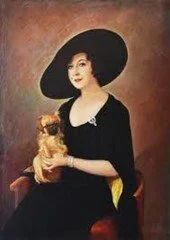
Style serves function.
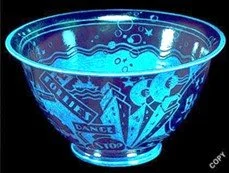
The Jazz Bowl he made for Eleanor Roosevelt in 1930 is an American Art Deco icon. He made it in the early days when, at age 26, he worked part-time at the Cowan Pottery Studio.
“It was the bottom of the Depression, and the Cowan Pottery Studio where I worked part time for Guy Cowan, my former teacher, received a number of letters requesting specific types of products from various galleries. I remember picking up one request from a gallery in New York City asking for a large punch bowl with a New York theme.
I thought about it awhile and felt that the City of New York reflected the excitement and energy of jazz music. I listened to a lot of it when I visited the city. I also felt that the bowl should be blue to mirror the strange blue tinged light that rose over the city at night. I started with plaster, creating a bowl and then went to white porcelain. I then started to use a rather primitive method of scratching [etching] an image on the surface of the bowl. This was a black and white technique. I then put on the bowl translucent copper and cobalt blue glazes that were then baked on.
A week after the bowl was shipped, the gallery owner called to say that the lady was so pleased that she wanted to order two more. She said that her husband Franklin loved it, too. One was to be sent to her house in Hyde Park, New York, and other was to be sent to the White House in Washington, DC. Though, I eventually spoke to her on the phone, I regret that I never met her in person”.
That quote by Shreckengost shows his personality as well as his good sense. Nothing captures the inner man as well as his own words: Simple words from a completely unpretentious man who thought more about the work in front of him, than any fame or gain that might come from it.
His work as an educator reflected the same philosophy. Despite the multitude of his other projects, he managed to teach at CIA for more than fifty years. He started with the Cleveland Institute of Art as ceramics instructor. By 933, Schreckengost was Director of the school’s Department of industrial design; the first of its kind in the country.
Many of his students went on to major design positions at: Ford, Nissan, Tecktronic Industries, Fisher-Price, Buick Reviera, and scores of others. He remained professor emeritus at CIA until his death in 2008, one year past his hundredth birthday.
I wish I had talked to him. I could have. We both lived in suburbs of the Greater Cleveland area for a very long time, I in North Royalton. He in Shaker Heights – only a few miles apart.
I’ve let many opportunities in life slide by. I let opportunity to talk personally with Victor Schreckengost slide by. It was one of the dumbest opportunities I didn’t take.
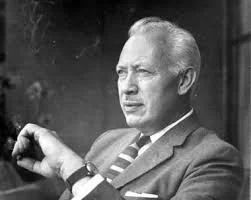
Victor Schrekengost – Designer - 1908 -
2008 photograph by Martin Linsey, 1950)