If you were to say, “I’ve seen the elephant” in the nineteenth century, you would be understood as saying, “I’ve seen it all”. In those days very few had seen an elephant. Very few in rural America had even imagined an elephant. “Wow, don’t that beat all”. Traveling circuses in the latter part of the 1800’s exploited strangeness.
Now those days seems a time of wonderous innocence.
These days, we all know it all, or think we do. We watch with jaundiced eye, rarely surprised, convinced of our sophistication. There’s nothing we can’t find on Google. Fact-Check gets it all correct. Things that don’t seem to fit are dismissed as meaningless anomalies.
These days, everybody’s seen the elephant”, or have they?
Very little obscures perception more than thinking you’ve seen it all. The Bible verse, “I see as though through a glass, darkly”, is still operative.
No one knows it all; They can’t, it’s not possible.
The talking heads of the Media ignore that truth. Doubt would slow the flow of narrative. Quibbling about facts wrecks storytelling. Seeing it all is not nearly as important as seeing what’s entertaining.
After all, It’s not like the News Business is actually in the business of truly reporting on what’s going on; it’s about Show Business.
Academics profess to be interested in what’s true, though being human, they sometimes torture honest data into suspicious alignments in order to make the data fit with their theory.
Some innocently fool themselves.
Some do it deviously.
Non-academics do it unconsciously as a matter of course.
People always find it easier to see what they want to see. Facts that say otherwise are annoying. Facts that say otherwise are swept under the rug or ignored outright. “Don’t confuse me with the facts, my mind is made up”.
The nineteenth century farmers that came to see the elephant probably saw a different animal than the one standing in front of them. Medieval Bestiaries and Cop Art renderings of the culprit, based on eye-witness memories come to mind.
It’s hard to see anything clearly when a preconceived model blocks the view.
The classic tale of blind men describing an elephant makes the effect obvious. The man holding the tusk says an elephant must be very like a spear. The man holding the tail says an elephant must be very like a rope. The man holding the leg says an elephant must be very like a tree, and so on.
Well, those guys were blind, of course they got it wrong.
We’re all blind to what we’re incapable of seeing. Some acknowledge their lack of seeing, others are confident there’s nothing left to see. Most are sure that what they’ve seen, they’ve seen clearly. The only thing I’m confident of is uncertainty.
Most of reality is ambiguous. Even the actuality our senses allow us to sense, are often confounded by mirage, masquerade, mirrors, and illusions - optical and otherwise.
Worse yet, our are senses are limited. Our sense of sight can see only see a small part of the spectrum. Our sense of sound hears only a small portion of audio frequencies, let alone whatever else is vibrating. The same is true of smell and touch.
Most of perception is guesswork. How much of what we think of as rational thought is assumption and belief? More than most of us would like to think - or admit. Still, it would be nice to know it all.
I’d like to say I’ve seen the elephant.
I’m not confident I can.
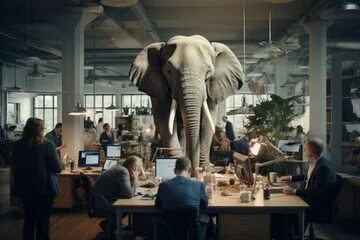
Despite abundant data, a lot elephants remain unseen.