Her first book, Tropisms, had neither plot nor characters. Chapters were unconnected and the sequence of the chapters was unimportant. One swirling of, recollection, fancy, or recrimination follows another, with no particular reason for any of it.
Then it ends, much like life.
The reading public wasn’t sure what to make of it. Some noted the graceful, artful, writing. Others focused on the confusion of meaning, or perhaps the absence of meaning. Still others, thought the book threw light on the psychological complexities of the human mind.
I’m not sure what Nathalie had in mind. I enjoyed it anyway.
Maybe enjoyed isn’t quite the right word. I’m not entirely comfortable reading private thoughts never intended for anyone to know about being spread out across the page for anyone to see.
It was more interesting than enjoyable.
Nathalie gave the name, Tropisms, to the muddle of fragmented thoughts and emotions that flicker and flash without permission in every mind. Tropisms seem like the disjointed flow of a dream where thoughts come and go, often without rational connection.
One critic opined: “The constantly shifting perspectives and points of view in Sarraute's work serve to undermine the author's hand, while at the same time embracing the incoherence of lived experience”.
Ms. Sarraute had a simpler explication of her writing.
Nathalie has said of her first thoughts on this stye of writing: “Suddenly I had a very strong impression of something . . . a sort of inner movement occurring as two people met and I wrote it down, just like a first poem, without knowing exactly what it meant”.
In 1990, an interviewer for the Paris Review asked, “You wrote your first novel at the age of twelve, then nothing until you were thirty-two. Why”?
Nathalie’s reply was unpretentiously honest.
“My mother wrote all the time, and to parrot her I wrote a “novel” full of all the platitudes I had read in love stories at the time. I showed it to a friend of my mother who said, Before writing novels one should learn to spell”!
Nathalie went on to interpret tropisms as the “interior movements that precede and prepare our words and actions, at the limits of our consciousness.”
She added, “I felt that a path was opening before me, a path that excited me. As if I'd found my own terrain, upon which I could move forward, where no one had gone prior to me, where I was in charge”.
She had invented a new way of writing that was all her own.
The Paris Review interviewer extrapolated on Nathalie’s interpretation of tropisms by saying, “They (tropisms) happen in an instant, and apprehending them in the rush of human interactions demands painstaking attention”.
Mmm, I don’t think Nathalie would put it quite that way. I think Nathalie just enjoyed imagining what people were secretly fretting about, a sort of imaginary eavesdropping of what is never heard.
I suppose tropisms might also be thought of as flow-of-consciousness writing, much like Proust, or James Joyce, except that tropisms seem too unstructured to be interior monologue.
Nathalie Sarraute was recognized by literary critics, but was never very famous. I hadn’t heard of her until recently, and then only by chance in a book of collected essays by Jean Paul Sarte.
The book was, Situations (1965). I had read it many years ago. I didn’t notice his essay on Nathalie Sarraute until I re-read it a few months ago.
The essay first appeared in a review by Sartre of Sarraute’s novel, Portrait of a Man Unknown (1948). Sartre also contributed a foreword. He referred to her novel as an anti-novel. He also spoke in the foreword about, Tropisms, including quotes from that book:
“He ought to be ashamed of himself . . . and she’s all he’s got in the world . . .well, he can’t take it with him, that’s certain . . . At least two million. And that’s only what Aunt Josephine left . . .He’s the one I fell sorry for. They had the most terrible scenes and arguments . . . . He won’t marry her . . . What he needs is a good housekeeper . . . ”.
I went to the library for a copy of Tropisms. That led me to writing this essay.
Maybe I’ll go back to the library for a copy of Portrait of a Man Unknown.
Her style is her own, and well worth reading.
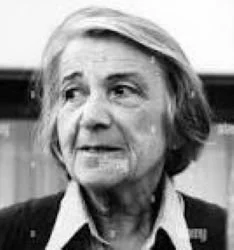
Nathalie Sarraute
Born, July 18, 1900,
in Czarist Russia.
Died, October 19, 1999, in Paris, France.