Any sequence of years with enough similarities can be thought of as an Era. Time, place, and commonly shared notions mark the boundaries of social Eras. The German word, zeitgeist, describes a social Era precisely. More words are needed in English to convey the same idea: a bunch of people who think a lot the same for a long time.
When an Era begins and when it ends is always fuzzy. Those questions don't interest me. What does interest me is how and why such times come and go.
The general nature of any Era is generally agreed upon, the causes of beginning and ending are disputed. Why and how, has many answers, few of them entirely reliable.
I have some entirely unreliable thoughts about four particular Eras. Worse yet, I'm shamelessly appropriating the large idea of Era to describe smaller ideas about shorter-lived cultural enthusiasms. I say, the time of the season is an Era.
1. The Literary Era: The years from the mid-1880's to the mid 1900's produced more serious literature than at any time before or since. That's my general impression. I think it's generally true. Serious writing happened before and has happened since, but no other time has had so many memorable writings read by so many serious readers.
The why of it may be because education was better and more available. The better part was slow in coming and it started faltering at the end of the 1950's. Still, that's a lot of years.
The novels of Charles Dickens, which were serialized in newspapers preceded the era. Dickens' stories turned infrequent readers into frequent readers. Advances in printing technology lowered the cost of books. Cheaper books combined with more frequent readers paved the way for an era of plentiful writings. More and cheaper books created more readers.
More readers created more sophisticated readers.
Sophisticated readers valued serious writers. This resulted in a decades-long "Era" of literary output that remains unrivaled in volume. The best authors of the Literary Era were the rock stars of their time; celebrated and revered.
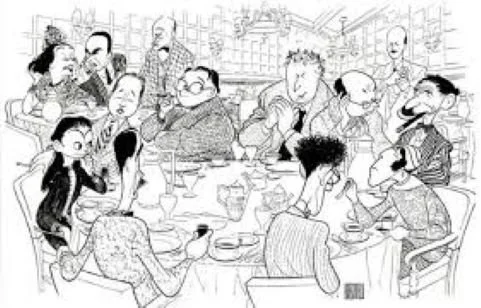
The pop fame of the literary wits who lunched
at the Algonquin Round Table personifies the Literary Era's
esteem for the written word.
The last of these literary stars were Hemmingway, Scott Fitzgerald, and, a handful of others. By the late 1950's, literate books were edged out by pedestrian books of self-help, melodramatic adventures, and silly romances - augmented with tedious navel-gazing novels by would-be bookish-writers that aspired to be taken seriously.
The output was dross compared to what was written before. The Literary Era was over; It began with better education and cheaper books. It withered with progressively poorer education and the birth of Rock & Roll.
2. The Rock n' Roll Era: The Rock Stars of the Rock n' Roll Era were Rock n' Roll musicians. The adulation once awarded writers was now awarded to the most influential of the musicians. Writers still wrote, readers still read, but serious literature was considered, not glamorous, but stuffy.
I judge the great days of enthusiasm as beginning in the middle of the 1950's and lasting to the middle of the 1970's. That's not exact, Eras never are. Nevertheless, it's about right.
I grew up in the declining years of the Literary Era and spent most of my adult life in the Rock n' Roll Era. That allowed me to appreciate both Eras. I'm happy for that. I'm sorry that so few of the younger generations have known the gratifications of literary enthusiasm.
Times change and Eras coincide.
Enthusiasm for the sports car, which is sort of a sub-era, coincided with the Rock n' Roll Era. Sports car enthusiasts listened to Rock n' Roll and some Rock n' Rollers drove sports cars, but what was gripping to the rockers was marginal to the roadster crowd.

The dashboard of my friend Eddie's TR-6. Eddie bought the car as a rusted ruin. Over the course of several years he restored it - in 2023 - to showroom splendor.The good things of any Era often have a life beyond the Era.
3. The Sports Car Era: The term, Sports Car, was first used in the late 1920's. Few Americans noticed. That changed in the early 1950's. I'm not sure why. The early sports car drivers were middle-aged men who were reliving some of their youthful dash when they got behind the wheel of a flashy sports car.
They were also old enough, and rich enough, to buy a car that was useless for anything other than riding around in style; sports cars were roadsters with two seats and minimal storage capacity. There was an aura of the race track in sports cars, though not many sports car drivers ever drove in a race. Nevertheless, there was plenty of talk about handling-ability and acceleration. The greatest attraction was the buzz of the ride.
Sports cars were fun.
That's why I bought three models during the early 60's. I was young in those days, I was hard-pressed to pay for them, I didn't care. They were fun.
I traded-in my old 56' Ford for my first sports car, a used MGA. A few years later I traded the MGA for a brand-new Austen Healy-3000. My last sports car was a TR-3.
I've had many cars since then, including a Cadillac Sedan De Ville. I enjoyed the TR-3 more than any car I've ever owned.
Sports cars are still fun - and impractical. The Era ended as an Era in the late 70's. Eras come and go. Enthusiasm waxes and wanes. The good stuff from any era lingers indefinitely.
Some enthusiasms never go away. Sports enthusiasm can't be considered as any sort of Era. It's ubiquitous draw is unchanged in every age and culture. Sports enthusiasm is hard-wired into the human psyche.
4. The Non-Era of Sports: Sports got started when Og stupidly interrupted the hunt in order to challenge Ug to a spear-throwing contest. That's the essence of sports, then and since; wasted time and energy directed to no other purpose than the thrill of competition. It's a thrill I've never experienced. Sports bore me. All games bore me.
Spectators at the bull-leaping ceremonies in long-ago Minoa were no doubt placing bets on which leaper leaped best. Gambling has always been the side-game at every sports game. That makes sense even when the game being bet on doesn't. At least there's some possibility of useful gain.
Sports have no real purpose beyond the ephemeral joy of winning. Sports-fans get nothing beyond the vicarious joy of their team winning. Old guys no longer capable of athletics get to shout, “go, go, go”, at real athletes who are already, go, go, going as fast as they can.
The perennial popularity of sports is a mystery I know about, but will never really understand.
Perhaps it's because I've only been on the planet
a short distance.
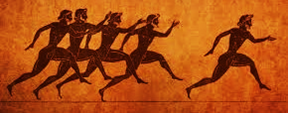
The Ancient Greek Olympic Games weren't the first spectator-sport games, but they might have been the first to formalize the idea.
