I've some odd thoughts. None are connected by anything but coincidence. Some might even be interesting. Some might even make sense.
Selective Seeing: What we see clearly might matter less than what we can't see clearly. Ambiguity inspires imagination. A confusion of clarity forces mind to decide what teases unsure perception. What we decide as true is decided aesthetically as much as reasonably.
We think some things should be true, even if they're not. Appealability often trumps verity. Decisions are opinions. Everybody has an opinion. Some opinions are actually true.
Anything that can't be measured is an opinion.
Being & Becoming: Every solid is busy dissolving. Microscopes reveal that the edge of anything is busy blending into whatever it's next to. Everything is connected to everything else by blurred boundaries of immigrant atoms that make absolute identity problematic.
This is obvious at the atomic level, and invisible at the macro level.
Is it true that what you can't see can't hurt you? Bacterial infections suggest otherwise.
Who knows what else.
Bon Mots: I define: bon mot as meaning: a good bit. A good bit might be a bit of chocolate or a tasty thought. Any small pleasantry might be a bon mot. I suppose even a witty enough sarcastic remark might be considered a bon mot; the wit suppling pleasantltry, despite intended nasty meaning.
Bon mots are judged-so by the taste-buds of the taster.
Identity Theft: Shouldn't banks and businesses
be held financially liable for I.D. scams? Why should customers ever be accountable for Internet theft? The main reason people entrust their money to a bank is to protect their money.
When a bank gives your money to someone that isn't you, the bank is as guilty of theft as the thieving I.D. hacker. The bank was remiss in protecting your account, therefore the bank should reimburse you for allowing your money to be stolen.
I think the same should apply to I.D. theft of any sort. Individuals shouldn't have to memorize multiple codes, PIN's, passwords, and assorted other abracadabra. Institutions should take care of all that - invisibly and behind the scene.
The job of protecting your identity should be entirely the responsibility of those institutions you've entrusted your identity to. Institutions will quickly discover how to protect your identity, without you doing the work - as soon as legislation makes them legally obliged to do the job.
Perhaps the rise of A.I. will provide institutions with one clever algorism to replace the annoying endless arrays of secret letters, numbers and punctuation marks.
The current situation is ridiculous.
Good Form: You can say that of anything well and properly done, from arts to sports to Forms. Forms? That’s right, Forms, the neglected child of business. Design is rarely seen in Forms. In fact, most forms look as though done with thoughtless regard for appearance, and with even less attention to function.
Appearance is the lesser problem. Nobody gets confused by bad aesthetics.
A lot of people get flummoxed by badly designed forms.
I’ve spent most of my life as a graphic designer. You might wonder why I would care about the design of such an unglamorous item as a Form. There’s no mystery to it.
I understand design as the means by which purpose is made clear, and disorder is made orderly.
Aesthetics is the second consideration of any design job. The first consideration is function. Not that good looking work isn’t important, it is, but before designing appearance the functional design of content must be solved. If a thing doesn’t work then it doesn’t matter how pretty
it is.
There’s a line in an old blues song that says it well: “She got the looks alright, but she can’t carry no heavy load”.
That applies to Forms as well as ladies. Fortunately, when you make Forms easy to fill-out you're already on your way to making them beautiful as well.
Function first, then aesthetics.
Forms represent a company as much as any other item of corporate identity. If you want to make a good impression, make sure you include smart, sensible Forms.
Most companies don’t understand the true worth of well-designed Forms.
Sun, Earth, Moon: Isn't it odd that the shadow of the Moon can so exactly eclipse the Sun. The reason for this is explained by simple geometry: The Moon is 400 times smaller than the Sun and the Sun is 400 times further from Earth than the Moon.
An explanation of how it got that way isn't so simple. That's the oddest part.
Precision isn't satisfactory explained by random coincidence.We don't expect natural occurrences to be so precise. It seems so planned.
Mmm? I read a book titled Rare Earth a few years ago. The authors, geologist Peter Ward, and cosmologist Donald Brownlee, believed precision only possible through intelligent design.
Intelligent design implies an Intelligent Designer.
An Intelligent Designer implies God.
Intolerable, gasped the unbelieving secularists.
"The Cosmos is created by nothing more than random balls bumping into other random balls. The appearance of planned pattern is an illusion of coincidence.
Sniff! Nothing more".
I guess I randomly find Ward and Brownlee's position more intelligent.
Questionable: I had a friend, Steve Farkas, who had a wonderful way of asking questions. It wasn't so much his wording as his calm patience in waiting for an answer. Steve would ask a simple question. When he was answered with a long, meandering monologue, Steve would nod and ask the exact same question again.
To ensure the exactness of his question, he would ask again, using the exact same words.
This technique was disquieting. The usual reaction was slightly startled alarm. "What's this guy up to. Is he simple minded, is he trying to insult me. . . or what"?
The truth is Steve was a very direct person who expected direct answers. I don't believe his style of questioning was ever about anything more. Doubters will doubt, I don't.
Simplicity is uncomfortably honest for many people; it makes them nervous. On the other hand, simplicity also invites open answers. That's what most often happened.
Since learning Steve's style of questioning, I've used it ever since.
Never properly thanked him.
Thanks, Steve!
Pinted Ladies: Some will be surprised to learn that the classic white statues of antiquity were originally painted in full color. Imagine the gleaming marble art of Praxiteles outraged by gratuitous "natural" color. No, no, no, impossible! The closest modern equivalent would be figures in a wax-museum.
Centuries of veneration for the classic statuary of Ancient Greece have convinced us that, classic, is synonymous with simple, pure, and unadorned. Decoration corrupts real beauty, and decoration cannot disguise lack of beauty.
Maybe that's why black & white movies so often seem classier than technicolor, and why lovely ladies look classier without makeup.
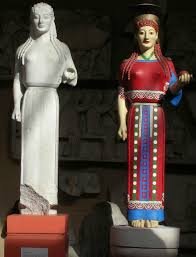
Without & With
The Last Days of Innocence: The days of childhood, from cradle to adolescence, are filled with play, every day, with no worry for the annoying disruptions that haunt the life of a grownup. We live. We eat. We play. We pay our attention only to what interests us.
We are free
Then, the World takes us in-hand.
Repeated smacks, bumps, and bruises convince us life is hard. life is earnest, no place for playing around. Suck it up and move on. That's just the way it is. Get used to it.
I never got used to it.
I've no intention of getting used to it. I do what needs doing. I don't spend any more time on doing necessary things than the necessary things require. I save most of my energy and enthusiasm for doing what interests me.
Life without play, without aimless wandering, without frivolous wondering, isn't worth living. Keeping your nose to the grindstone guarantees a sharp nose and a dull mind.
I work best when I'm not working.
It's also more fun.
Peter Pan was a very wise child.
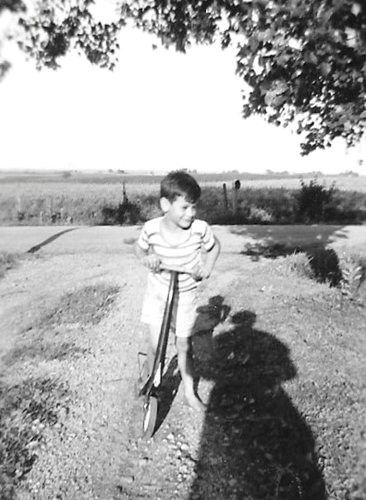
Those were the days.