The first I ever heard of a Silkie was when I heard Joan Baez sing the Child ballad / 113. I didn't know, at the time, any more about Child ballads than I knew about Silkies.
Even so, the haunting lyrics of the song touched some ancient predilection I didn't realize I had: I'm drawn to old tales of mystic connections between this world and a different world that magically exists alongside.
My predilection is shared by many others who suspect those misty tales of supernatural enchantment might have some truth at their origin. If they aren't true, we still like to imagine they might be true
The poetry in, The Great Silkie of Sule Skerry, is reason enough to listen.
"An earthly nurse sits and sings / and aye, she sings ba lily wean / And little ken I my bairn's father / Far less the land where he dwells in"
Five more verses tell the rest of the tale. A mysterious stranger appears and tells the woman that he is father to the child. He also tells her, "I am a man upon the land / I am a silkie on the sea / And when I'm far and far frae land / My home, it is in Sule Skerrie".
Then, the mysterious stranger hands a purse of gold to the woman saying, "Give to me my little young son / And take thee up thy nurse's fee".
He adds, that on some summer's day, "I'll come and fetch my little young son / And teach him how to swim the faem"
The stranger ends his unexpected visit with a grim prophecy, "And ye shall marry a gunner good / And a right fine gunner I'm sure he'll be / And the very first shot that e'er he shoots / Will kill both my young son and me"
What a strange story it is of dark fate as certain as a Greek tragedy.
There are many versions of the song, in some, The Great Silkie is called The Gray Silkie, which does make more sense. Archaic words appear in all the versions.
The lyrics used in the Joan Baez version translate some of the archaic words, but not all.
In other, older versions of the lyrics, nurse is spelled: nourris. Nourris means: wetnurse. Ba lily wean means: howl, lovely child! Ken means: to understand. The word, dwells, is substituted for, staps, which means: stops or stays.
The older words don't change the story, but they do add hints that more may be going on than is sung. Why would a wetnurse sing, "howl, lovely child", to her charge? Does the wetnurse have precognition of fated tragedy yet to come. The word, staps, instead of, stays, implies some, meaning more like, "Who knows to what queer places your rambling father travels".
In another verse, when the Silkie father returns in human form, he's described as grumly. The word, grumly, means: troubled.
The motif of troubled fate compels listener attention. What will happen next How will the story end? It's a storytelling strategy that always works. In the case of age-old songs sung for ages, there is another wondering as well - could it be true, or partially true?
Centuries of listeners from the Orkney Isles, and from sea-bound northern lands nearby and far, have no doubt the story is true. The sea and the creatures therein are both well-known and mysterious. The depths below the gray waves hide all sorts of strangeness.
Sea monsters, mermaids, and assorted other unlikely creatures are considered by the islanders, but only with a grain of salt.
'Round Orkney, Silkies are considered a lot more likely.
Stories of the seal-people are very old. They are said to be a race neither human nor animal, but capable of being either/or as they choose. Their transformation has only one constraint: If their sealskin is lost or withholden, they are trapped in human form. If their sealskin isn't recovered they remain in human form.
Many sorrowful tales are told of Silkies imprisoned for life as humans with no option of return to the churning gray waves they love.
Tales of human becoming animal and then back again are older than the Stone Age. Every paleolithic culture in the world has their own version, including modern-day paleolithic cultures from Siberia to the Amazon.
The Shapeshifter In the Indian stories of the American southwest is called a Skinwalker. Skinwalkers are usually malevolent, Silkies usually aren't, otherwise they're the same.
Other sorts of Shapeshifters can change into any animal they choose. Silkies can only choose between human or seal.
Those who don't believe in Silkies wonder, why a seal? One reason might be because there are a lot of seals around the Orkney Islands. Local seals and local people have frequent friendly contact. Fishermen tell of curious seals who pop-up around their boats apparently interested in socializing. If the fishermen sing, the seals listen raptly as long as the singer sings.
There is an impression on both sides that seals and humans have a lot in common.
I saw a nature film a few years ago that affirms the impression. An American woman on vacation in the Orkneys encountered a seal on the beach. They became friends. They swam together every day of the ladies vacation.
Each day the seal would come to the edge of the sea and call for the human friend to come swimming.
I don't recall how the film ended. I imagine the lady would have liked the seal to come home with her. I imagine the seal would have liked the lady to stay in Orkney.
If seals and humans mix so easily, transformation of each into the other is much easier to imagine.
Local lore hints at older possibilities.
One clan in the Outer Hebrides claims descent from Silkies. In addition to their well-preserved aural history there is also a physical aspect. Many of the clan have skin growths between their fingers that are almost, but not quite, webbing. The condition is known to occur in other parts of the world, but the condition is rare. In the group that claims descent from Silkies, it's thought not worth remark.
Not proof, but interesting.
A more fanciful theory is suggested by people adverse to mystery: ancient Celts might have had relations with dark-haired Finnish, or Sami women - who often wore and disrobed seal-skins that might, from a distance, look like a seal shedding its skin to appear human.
I'm skeptical of that mystery-skeptical notion. Sule Skerry is a rocky islet twenty-five miles west of Hoy Head in Orkney. Anyone can visit and get a notion of their own.
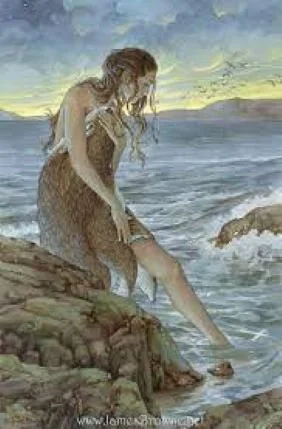
Is this a painting of a dark-haired Finnish, or Sami women,
slipping out of her seal-skin garment - or is it a Silkie
charmingly caught in the very act of transforming?
I prefer the latter.