In 1963, Mississippi John Hurt recorded Coffee Blues,
a sweet tune about the simple joy found in "a lovin' spoonful" of Maxwell house coffee. I liked that tune then, and I like it now. I've since switched to a lovin' spoonful of Starbucks, but I appreciate the treat just as much as Mississippi John Hurt appreciated his lovin' spoonful of Maxwell house.
The simple joy found in "a lovin' spoonful" of anything is what I really appreciate.
John Sebastian liked the notion of "a lovin' spoonful" so much he named his band after it. I like the notion so well, I'm naming this essay after it.
The apparently endless outpouring of entrancing new music in the Sixty's seemed like a "lovin' spoonful" from a magical horn-of-plenty. Such sustained bursts of creativity are rare in history.
I don't think I'm alone in noticing that.
Times and places that welcome iconic dreamers are few and far between. The Golden Age of Greece, the Renaissance, and . . . What else comes to mind?
Not much else comes to mind.
For reasons unfathomable, the Muses knocked on the door in the middle of the twentieth century singing, "Let your freak-flag fly". Restless youth ran to the door saying, "Come on in".
The outpouring of art and imagination went on - and on - and on.
It was intoxicating stuff. Few times in history have produced so much wonderful work, concurrently, for so many years.
Many will disagree. Many thought the era disgusting. They have a case. I don't quibble with their case, but I remember best, the best of those years.
Little Richard, and a handful of other Rock n' Rollers, set the stage for nascent revolution in the 1950's. A multitude of innovators in the 1960's, elevated Little Richard's primal howling assault on the piano into previously unconsidered complexity.
Rock n' Roll morphed into Rock.
Even so, Rock n' Roll never went away. The Beatles, Rolling Stones, Grateful Dead, Velvet Underground, Pink Floyd, and a thousand forgotten other bands added, daily, to the mix.
The possibilities seemed unending.
At the same time long-haired Hippies preached Peace, Love, Free Sex, and home-grown hallucinogens. By the end of the Sixty's, coke crank, heroin, designer drugs, and politics were added to the mix.
Many were true believers in the politics. More were in it just for the sex, drugs, and Rock n' Roll.
I never had much use for the politics. The street theater of waving signs and chanting slogans in the streets was stupid then, and still is.
I did enjoy the music and hallucinogens.
It started in America, then quickly spread - first to England, then beyond. Young men in London thought the Sixty's culture a smashing idea; their mini-skirted Birds agreed, they loved the beat because they could dance to it.
Girls and boys, alike, loved the freedom and excitement. It wasn't so much that every day was a party, as it was that every day seemed like a party.
"Somethings going on, but you don't know what it is, do you, Mr. Jones"? The children enjoyed being hip, when parents and authorities were befuddled.
This was an illusion that satisfied pubescent aspirations, but nothing satisfied them as much as the festival of new ideas, new music, and ever-expanding freedom.
Two words captured the zeitgeist of the era: Rock on!
And so the bacchanal flourished across two continents and eventually the world, for nearly a decade.
I put the era as roughly from 1965 to 1975. Dating of the timeline remains a matter of opinion.
No matter how long it lasted, It was a long, long, long, lovin' spoonful.
The Newport Jazz Festival kicked it off. The zenith was reached at Woodstock. The debacle of a black man stabbed to death by a Hell's Angels thug at the Altamont Rolling Stones concert killed the era. The glow was gone.
Sobriety had its way with the dreamers.
Nonetheless, I remember the era fondly, even though others saw those times as nothing more than damnable excuse for self-indulgence, guiltless fornication, and dodging the Draft.
The "straight" world thought the Sixties an evil time of Satan rising. The "hip" world thought it more a time of Orpheus rising, and about time, too.
Most hadn't heard of Orpheus, but the better schooled among them would explain, and the rest would agree. Me too, but that was then.
Times now ain't like they used to be. These days,
I too, see Satan rising.
This time, for real.
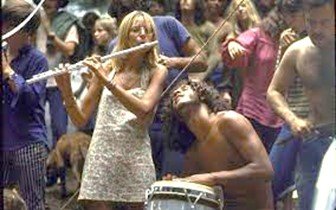
Sweet dreams at Woodstock.